


Are Your Compostable Garment Bags Really Certified? 7 Checks Before You Buy
Compostable Garment Packaging Buying Guide
Are Your Compostable Garment Bags Really Certified?

As garment manufacturers and apparel exporters move towards more sustainable packaging, compostable garment bags are becoming an important alternative for packaging requirements.
However, the words biodegradable, eco-friendly and compostable should not automatically be treated as proof that a packaging product meets a recognized requirement.
For garment manufacturers, exporters, retailers and e-commerce businesses, the important question is not simply whether a bag is described as compostable. You should also understand what standard it follows, what documentation supports the claim, how the bag is labelled and under what conditions it is intended to compost.
Before placing a bulk packaging order, use these seven checks.
Compostable vs Biodegradable: What Is the Difference?
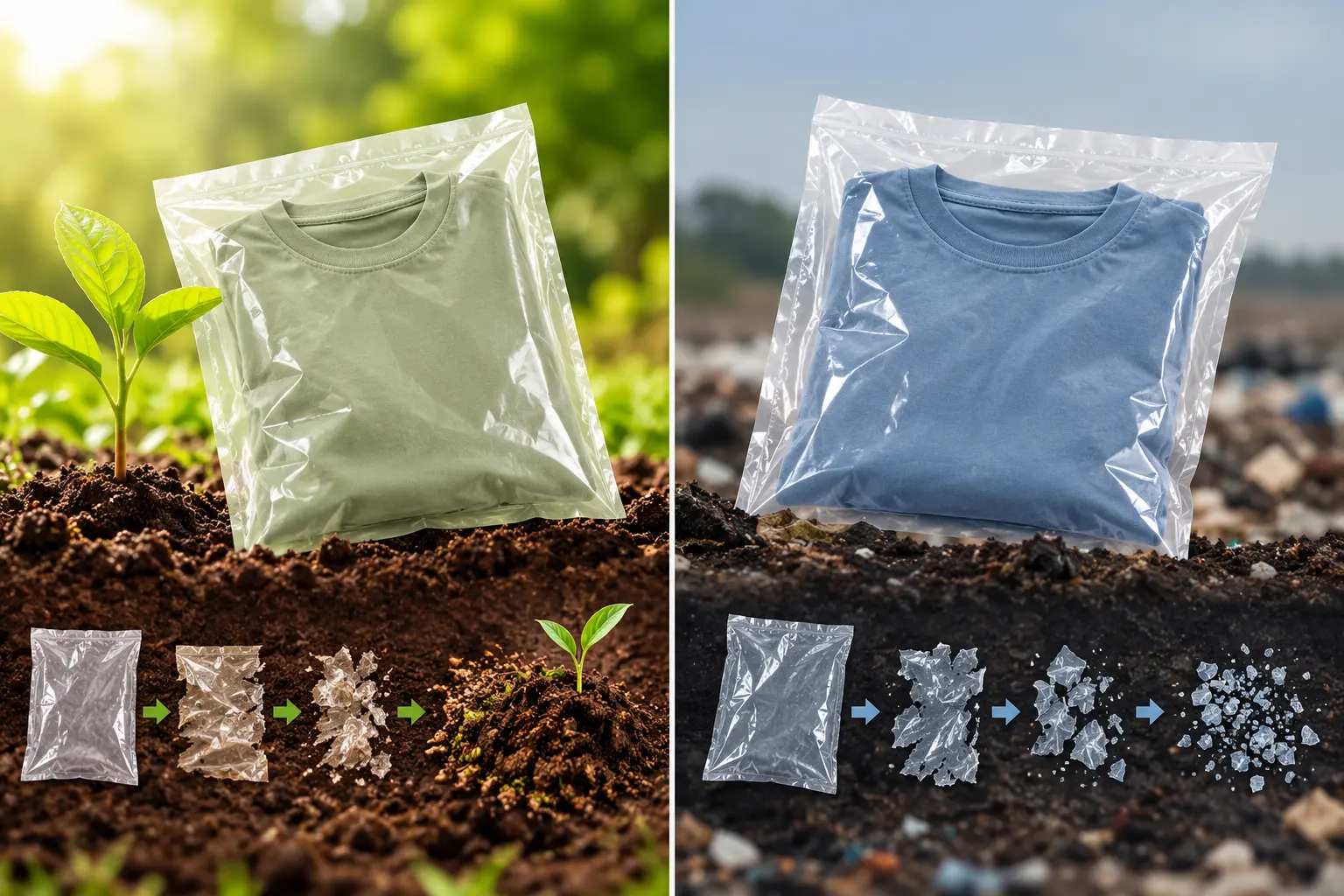
The terms are related but should not be used interchangeably.
Biodegradable generally describes the ability of a material to break down through biological activity under specified conditions.
Compostable packaging has more specific requirements related to its performance under a defined composting process. For example, ASTM D6400-26 covers plastics and products designed for aerobic composting in municipal and industrial composting facilities.
ISO 18606:2013 also addresses packaging suitable for organic recycling, including biodegradation, disintegration during biological treatment, effects on the biological process and the quality of the resulting compost.
For garment businesses, therefore, the specific claim and supporting documentation matter more than a generic “eco-friendly” label.
1. Ask for the Relevant Certification or Compliance Documentation
Do not rely only on a supplier’s product description.
Ask the supplier to provide the applicable:
- Certification details: Relevant certification information supporting the compostability claim.
- Certificate number: The certificate number where applicable.
- Testing documentation: Test reports or supporting laboratory documentation.
- Material information: Details about the material used to manufacture the bag.
- Manufacturer details: Information identifying the manufacturer associated with the documentation.
- Validity or status: Current validity or status of the supplied documentation.
- Applicable standard: The standard or specification against which the product is assessed.
In India, CPCB guidance states that manufacturers or sellers of applicable compostable plastic carry bags/products are subject to certification requirements under the Plastic Waste Management framework.
2. Check Which Compostability Standard Applies
A statement such as “100% compostable” is not a complete technical specification.
Ask:
- Which standard does the product conform to?
- Is the claim related to industrial composting?
- Which testing requirements were followed?
- Does the documentation correspond to the actual bag material?
For example, ASTM D6400-26 specifically addresses plastics intended for aerobic municipal and industrial composting facilities.
India’s updated plastic-waste guidance also references IS/ISO 17088:2021 for compostable plastics and specifies labelling requirements for products made from compostable plastics.
3. Verify the Actual Material Used
The certification or test documentation should relate to the actual material structure of the bag.
Ask the supplier about:
- Polymer or material composition
- Additives, if applicable
- Film structure
- Thickness
- Colouring materials
- Printing inks
- Closures or additional components
- Whether all components are covered by the relevant requirements
This is particularly important for garment packaging because a bag may contain components beyond the main film.
ISO 18606 notes that packaging components need to meet applicable requirements for the packaging to be considered suitable for organic recycling, subject to the standard’s provisions on separable components.
4. Check the Product Labelling
Proper labelling helps buyers and end users understand how a compostable product should be handled.
For applicable compostable plastic packaging, Indian rules specify the label “compostable only under industrial composting” along with conformity to IS/ISO 17088:2021.
Before approving printed garment bags, check whether the required information is correctly represented on:
- Bag artwork
- Packaging
- Product documentation
- Supplier records
5. Understand the Intended End-of-Life Conditions
Compostable does not mean that the bag will necessarily break down in every environment.
Ask the supplier:
- Is it designed for industrial composting?
- What composting conditions are required?
- What disposal route is intended?
- What documentation supports the stated end-of-life claim?
ASTM D6400-26 specifically refers to aerobic municipal and industrial composting facilities, while ISO 18606 does not treat littering as an organic-recycling route.
For garment exporters, this distinction is especially important when packaging is being supplied to markets with specific sustainability or waste-management requirements.
6. Check the Bag Specification for Your Garments
Certification is only one part of selecting packaging.
The bag should also match your actual garment-packing process.
- Bag length: Suitable for the garment size.
- Bag width: Adequate product coverage.
- Thickness: Suitable for handling requirements.
- Closure: Flap, seal, zip or other required format.
- Printing: Branding and required information.
- Transparency: Appropriate product visibility.
- Strength: Suitable for packing and handling.
- Quantity: Matches production requirements.
- Packaging: Suitable for storage and dispatch.
For example, an apparel exporter shipping folded garments may require different dimensions and closure specifications from a retailer packaging individual fashion products.
7. Request Samples and Documentation Before Bulk Production
Before approving a large packaging order, request a sample along with the relevant product documentation.
Check the sample for:
- Dimensions
- Thickness
- Seal quality
- Printing clarity
- Closure performance
- Appearance
- Handling during garment packing
- Compatibility with your existing packing process
Also compare the sample with the documentation supplied by the manufacturer.
Supplier Selection → Documentation Review → Sample Approval → Specification Confirmation → Artwork Approval → Production → Quality Inspection → Dispatch
What Should You Ask a Compostable Bag Supplier?
Before approving your supplier, use this checklist:
- Is the product supported by applicable certification?
- Which standard does it follow?
- Can the relevant documentation be verified?
- What material is used?
- What are the bag dimensions and thickness?
- What disposal conditions apply?
- What labelling is required?
- Can the supplier provide samples?
- Can the bags be customized for garment packaging?
- Can the supplier provide documentation for your procurement records?
Choosing Compostable Garment Bags for Your Business
For garment manufacturers and exporters, selecting compostable packaging should involve more than checking whether a product is advertised as environmentally friendly.
You need to consider documentation, applicable standards, material composition, labelling, end-of-life conditions and actual packaging performance together.
If you are looking for biodegradable compostable bags for garments , Real Packers provides customized compostable packaging solutions for garment and other business applications. The product can be specified according to required dimensions, printing and packaging requirements.
Frequently Asked Questions
Check the applicable certification, standard, material documentation, product labelling, intended composting conditions, bag specifications and sample quality before approving the product.
No. The terms describe different characteristics. Compostability relates to performance under specified composting conditions and applicable requirements.
ASTM D6400-26 is a specification covering plastics and products designed for aerobic composting in municipal and industrial composting facilities.
Indian plastic-waste guidance references IS/ISO 17088:2021 for compostable plastics and specifies applicable labelling requirements.
Yes. A sample allows you to verify dimensions, thickness, closure, printing, handling and compatibility with your garment-packing process before production.
Yes. Depending on the manufacturer’s capabilities, garment bags can be specified by dimensions, thickness, printing, closure and other packaging requirements.
Not necessarily. The applicable compostability claim should specify the relevant conditions. For example, ASTM D6400 addresses aerobic municipal and industrial composting facilities.
Need Compostable Garment Bags for Your Business?
Share your garment type, bag dimensions, quantity, printing requirements and required documentation with Real Packers to discuss a suitable compostable packaging specification.